
 English
 Español

Home / News / How M-TPU, TPEE, and PEBAX Foams Outperform Traditional Structural Foam Materials?
1. Introduction: The Evolution of Polymer Foams
The shift from conventional polyolefin and polyurethane foams to next-generation polymer foams has been driven by demands for higher energy return, lower density, and extended durability. Among these advanced materials, perforated TPU foam sheet, M-TPU foam sheet, M-TPEE foam sheet, and M-PEBAX foam sheet represent distinct families of thermoplastic elastomers processed into microcellular architectures. This article provides a rigorous, data-informed comparison of their mechanical behavior, thermal stability, and structural performance as structural foam materials.
Unlike traditional closed cell foam products that suffer from rapid compression set or poor resilience, these advanced foam materials leverage precisely controlled nucleation and expansion to achieve uniform cell diameters below 50 microns. Such microstructures enable exceptional fatigue life while retaining soft-touch aesthetics. The following sections dissect each material’s unique formulation, mechanical fingerprints, and practical design trade-offs.
2. Microcellular Foam Fundamentals
2.1 Defining the Microcellular Regime
A microcellular foam is typically defined as having cell sizes between 1 and 100 µm and cell densities exceeding 10^9 cells/cm³. Both M-TPU foam sheet and M-PEBAX foam sheet achieve cell diameters in the 20–60 µm range, yielding density reductions of 50–70% relative to their solid counterparts. This structure preserves tensile strength while dramatically lowering thermal conductivity and weight.
2.2 Closed Cell vs. Open Cell Morphology
All four foam types discussed here are predominantly closed cell foam systems, meaning each gas bubble is fully encapsulated by the polymer matrix. This provides superior moisture resistance, floatation, and thermal insulation compared to open-cell alternatives. However, perforated TPU foam sheet introduces engineered through-holes to tailor breathability and acoustic damping, creating a hybrid structure that retains closed-cell cores with controlled perforations.
3. Detailed Material Profiles
3.1 M-TPU Foam Sheet (Microcellular Thermoplastic Polyurethane)
M-TPU foam sheet is produced via supercritical nitrogen (N₂) or carbon dioxide (CO₂) foaming, yielding a uniform closed cell structure with cell sizes typically 30–50 µm. The base TPU provides outstanding abrasion resistance (DIN abrasion ≤ 30 mm³) and a Shore hardness range of 70A–85A after foaming. Density can be tailored from 0.15 g/cm³ to 0.45 g/cm³, allowing engineers to balance cushioning versus structural support. One notable characteristic is its high-rebound foam behavior: rebound resilience often exceeds 55%, making it suitable for impact-absorbing layers in dynamic equipment.
Under cyclic compression (50,000 cycles at 50% strain), M-TPU foam retains >90% of its original thickness, significantly outperforming ester-based polyurethane foams which typically show 70–80% retention. This durability stems from the low hysteresis of TPU’s segmented copolymer architecture.
3.2 M-TPEE Foam Sheet (Microcellular Thermoplastic Polyester Elastomer)
M-TPEE foam sheet leverages the high-temperature performance of polyester elastomers. While TPU foams soften above 70°C, TPEE maintains mechanical integrity up to 120°C due to its crystalline hard blocks. The microcellular structure of M-TPEE exhibits cell diameters of 20–40 µm, often smaller than TPU because of the higher melt strength during foaming. This translates to a smoother surface finish and lower gas permeability. Density ranges from 0.20 g/cm³ to 0.50 g/cm³, with compressive strength roughly 30% higher than M-TPU at equivalent density.
In chemical resistance tests, M-TPEE shows excellent stability against oils, fuels, and dilute acids, whereas TPU can swell in polar solvents. Therefore, automotive under-hood components and industrial sealing applications frequently specify M-TPEE foam.
3.3 M-PEBAX Foam Sheet (Microcellular Polyether-block-amide)
M-PEBAX foam sheet represents the highest tier in terms of low-temperature flexibility and energy return. PEBAX (polyether-block-amide) copolymers combine polyamide hard blocks with polyether soft blocks, producing an elastomer with exceptional fatigue resistance even at -40°C. The microcellular version achieves densities as low as 0.12 g/cm³ while maintaining a tensile strength of 4–6 MPa. Its rebound resilience often exceeds 70%, the highest among the four families, which is why it is favored in high-performance sports gear and orthopedic devices.
However, M-PEBAX foam has higher raw material cost and requires more precise processing conditions. The closed cell structure is notably uniform (cell size 15–35 µm) and provides superior water vapor transmission control, making it suitable for breathable yet waterproof laminated structures.
3.4 Perforated TPU Foam Sheet – A Specialized Variant
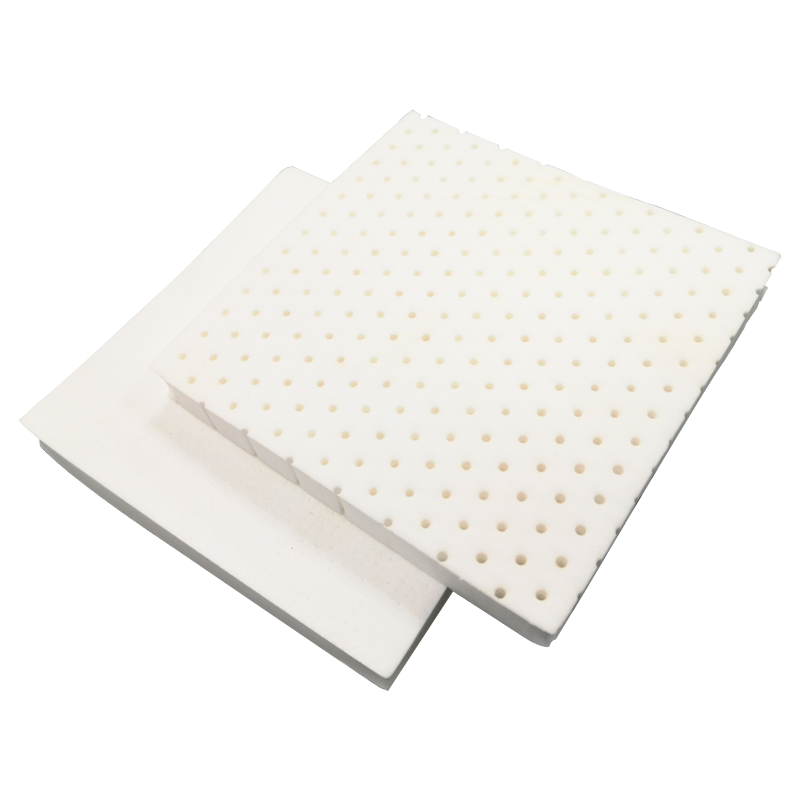
Perforated TPU foam sheet starts with a standard M-TPU foam core then undergoes mechanical or laser perforation to create an array of through-holes (typically 1–3 mm diameter, spaced 5–15 mm apart). This modification transforms the acoustic and airflow characteristics without fully compromising the closed cell structure. The perforated version achieves a noise reduction coefficient (NRC) of 0.4–0.6 compared to 0.1–0.2 for non-perforated TPU foam. It is widely adopted in automotive dashboards, office chair cushioning, and protective cases where passive ventilation is required.
4. Comparative Performance Matrix
The following table summarizes key engineering parameters for the four different foam types discussed. Values represent typical ranges derived from industrial testing under ASTM or ISO standards (without brand-specific data).
| Property | M-TPU Foam | M-TPEE Foam | M-PEBAX Foam | Perforated TPU |
|---|---|---|---|---|
| Density (g/cm³) | 0.15 – 0.45 | 0.20 – 0.50 | 0.12 – 0.40 | 0.16 – 0.46 |
| Rebound Resilience (%) | 55 – 62 | 45 – 52 | 68 – 75 | 50 – 58 |
| Compression Set (50%, 23°C, 22h) % | 8 – 12 | 15 – 20 | 5 – 8 | 9 – 14 |
| Max Service Temp (°C) | 70 | 120 | 80 | 70 |
| Tensile Strength (MPa) | 3.5 – 5.5 | 5.0 – 8.0 | 4.0 – 6.0 | 3.0 – 4.5 |
| Oil/Fuel Resistance | Fair | Excellent | Good | Fair |
| Relative Cost | Moderate | High | Very High | Moderate+ |
This comparative data illustrates that no single material dominates all metrics. M-PEBAX excels in resilience and low compression set but commands a premium price. M-TPEE offers heat and chemical resistance, while M-TPU foam sheet provides a cost-effective balance for general cushioning. The perforated TPU foam sheet adds acoustic and breathability features, making it a specialized variant.
5. Structural Foam Composites and Hybrid Constructions
Modern engineering frequently combines these foam materials with skins, scrims, or reinforcing layers to form foam composites. For instance, a laminate consisting of a 2mm M-PEBAX foam core sandwiched between two 0.3mm TPU skins can achieve a flexural modulus 400% higher than the foam alone. Such structural foam materials are used in lightweight automotive floor panels and drone landing gear.
Another emerging trend is co-extruded bi-layer foams: a bottom layer of M-TPEE foam sheet (high thermal stability) bonded to a top layer of M-TPU foam (soft touch). The interfacial adhesion is achieved without adhesives by exploiting the thermoplastic nature of both polymers. This design reduces delamination risk and streamlines recycling.
Design Insight: When targeting weight-sensitive applications, consider using closed cell foam with densities below 0.2 g/cm³. M-PEBAX at 0.12 g/cm³ offers the highest specific energy return (rebound/density ratio ≈ 600) versus M-TPU (≈ 360) and M-TPEE (≈ 250). This makes PEBAX the first choice for athletic footwear midsoles where every gram matters.
6. Processing and Manufacturing Considerations
6.1 Foaming Techniques
All three microcellular sheets are produced using either batch foaming with supercritical fluids or continuous extrusion foaming. Batch foaming offers tighter cell size control (±5 µm) but lower throughput. The typical parameters are:
- M-TPU: Saturation pressure 15–25 MPa, temperature 120–150°C, depressurization rate >100 MPa/s.
- M-TPEE: Requires higher temperature (160–190°C) due to its higher melting point; CO₂ as blowing agent yields finest cells.
- M-PEBAX: Narrow processing window; nitrogen preferred to avoid hydrolysis; cell nucleation promoted by talc or silica at 0.5–2 wt%.
6.2 Post-Forming Operations
Perforated TPU foam sheet is typically processed using rotary die punching or laser drilling. Laser drilling produces cleaner hole edges without thermal degradation if pulse duration is kept below 100 µs. Hole geometry (tapered vs. straight) affects airflow resistance: tapered holes (larger on the exit side) reduce pressure drop by 30%.
7. Application Case Studies (Brand-Neutral)
Case A – High-End Sporting Equipment: A manufacturer of protective vests needed a foam that could absorb repeated impacts without densification. After testing several different foam types, they selected M-PEBAX foam sheet (density 0.18 g/cm³, thickness 10 mm). The material passed 10,000 impact cycles at 5 J energy with less than 5% force attenuation loss, outperforming traditional EVA foam which failed after 2,000 cycles.
Case B – Automotive Lightweighting: An electric vehicle battery cover required thermal insulation and compression resistance. A 6 mm M-TPEE foam sheet (density 0.30 g/cm³) was compression-molded to a complex shape. It reduced the cover weight by 60% compared to solid rubber, while maintaining a thermal conductivity of 0.045 W/m·K. The closed cell structure prevented moisture ingress even under high humidity (95% RH, 85°C).
Case C – Acoustic Management: For a commercial HVAC system, engineers integrated perforated TPU foam sheet (3 mm thickness, 2 mm holes at 10 mm pitch) into the duct lining. The result was a 12 dB reduction in mid-frequency noise (500–2000 Hz) compared to non-perforated foam, with only 8% increase in pressure drop. The foam also resisted microbial growth due to its hydrophobic nature.
8. Future Trends in Microcellular Elastomers
Advancements in advanced material science are pushing cell sizes below 10 µm, leading to nanocellular foams. Early prototypes of nano-M-TPU exhibit transparency and dramatically reduced thermal conductivity (0.025 W/m·K). Additionally, bio-based TPU and TPEE feedstocks (derived from castor oil or corn) are entering production, enabling sustainable foam composites with reduced carbon footprint. Another frontier is 4D foaming—where the foam shape changes in response to temperature or humidity—currently explored with M-PEBAX due to its tunable block chemistry.
9. Frequently Asked Questions (FAQ)
Q1: What is the main difference between M-TPU and M-TPEE foam sheets?
A1: The primary difference lies in thermal resistance and chemical stability. M-TPU foam sheet offers better low-temperature flexibility and higher rebound, but its maximum continuous service temperature is around 70°C. M-TPEE foam sheet can withstand up to 120°C and resists oils and fuels, making it suitable for under-hood automotive components. However, M-TPEE has lower resilience (45–52% vs. 55–62%).
Q2: How does perforation affect the closed cell structure of TPU foam?
A2: Perforated TPU foam sheet maintains closed cells in the bulk region, but the perforations create open channels. This reduces the overall closed cell content from nearly 100% to about 85–95% (depending on hole density). The remaining closed cells still provide floatation and thermal insulation, while the channels enable air permeability and acoustic absorption. The material does not become fully open-cell; it's a hybrid design.
Q3: Which foam material offers the highest rebound for energy return applications?
A3: M-PEBAX foam sheet consistently delivers the highest rebound resilience, often 68–75% under standard ball rebound tests (ASTM D2632). This is significantly higher than M-TPU (55–62%) and M-TPEE (45–52%). For applications like running shoe midsoles or high-frequency vibration dampers, M-PEBAX is the preferred high-rebound foam choice.
Q4: Can these foam sheets be thermoformed or molded into 3D shapes?
A4: Yes. All three materials are thermoplastic and can be thermoformed at temperatures 20–40°C above their softening points (for M-TPU: 140–160°C; M-TPEE: 180–210°C; M-PEBAX: 150–170°C). Compression molding with female/male tooling is common. However, M-PEBAX requires slower cooling to retain its microcellular structure. Perforated sheets should be thermoformed with caution because holes may distort; pre-heating with infrared is recommended.
Q5: How do I select between different foam types for a structural application?
A5: Follow a weighted decision matrix. Define key criteria: (1) operating temperature range, (2) required rebound or energy return, (3) chemical exposure, (4) cost target, (5) density limit. If temperature <70°C and resilience matters most → M-PEBAX or M-TPU. If temperature >100°C and chemical resistance needed → M-TPEE. If acoustic or air permeability needed → perforated TPU foam sheet. For high-impact protection with low compression set → M-PEBAX.
Q6: Are these foams recyclable?
A6: As thermoplastic elastomers, M-TPU, M-TPEE, and M-PEBAX are theoretically recyclable via regrinding and re-extrusion. However, the microcellular structure is destroyed during recycling; the regrind is typically used as a filler in non-foam applications. Closed-loop recycling of foam sheets is still under development, but some manufacturers accept post-industrial scrap for reprocessing into low-grade sheets or blends. Perforated TPU foam sheet scrap is similarly recyclable.
 ++86-0512-66079229